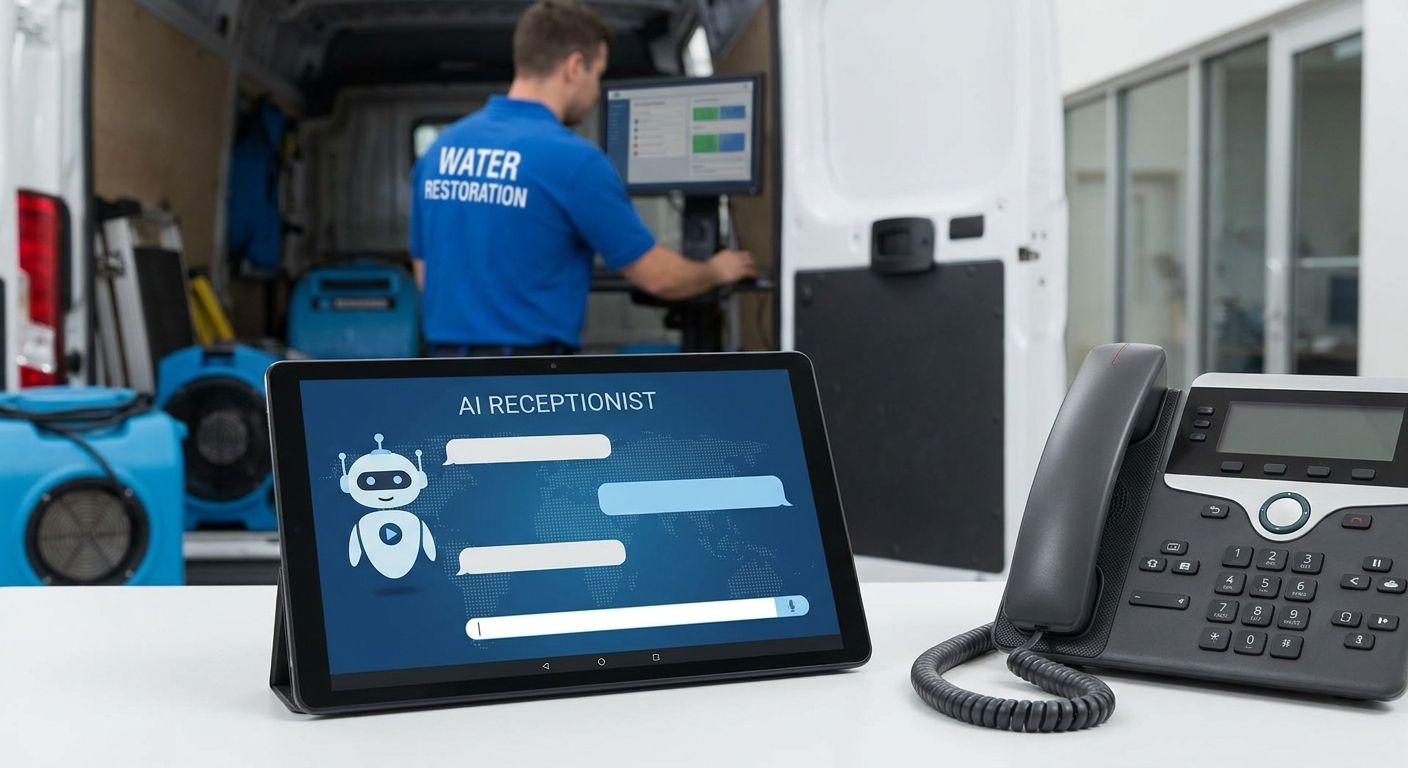
Water damage jobs get won or lost in the first phone call — and if that call goes to voicemail, the homeowner is already dialing the next name on Google. This guide breaks down what to demand from an AI receptionist for water damage restoration companies, and which type of call-answering setup actually stops jobs from leaking to competitors.
- SkipCalls wins for water damage restoration crews that need 24/7 emergency intake — Buy.
- Traditional answering services lack dispatch logic for burst pipes and flood calls at 2 a.m. — Consider only as a stopgap.
- Voicemail and callback loops cost restoration companies same-day jobs when mold risk starts at 24-48 hours — Skip.
- An ai receptionist for water damage restoration must capture insurance and loss-type details on the first call, not the third.
Why this matters
Water intrusion calls don't wait for business hours. A pipe bursts at 11 p.m., a sump pump fails during a storm, a basement floods on a Sunday — and the restoration company that answers first usually gets the job, not the one with the better trucks. IICRC guidance puts mold growth risk starting within 24-48 hours of water exposure, so every hour a call sits unanswered is an hour closer to a bigger, costlier job the homeowner didn't sign up for.
Most restoration companies still route after-hours calls to voicemail, a rotating on-call cell phone, or a general answering service that has no idea what "Category 3 water" or "insurance adjuster callback" means. That gap is exactly where an AI receptionist built for the trades earns its keep — answering every call, capturing the details a technician needs, and getting the job on the calendar without a human standing by.
Who this is for
This guide is for owners and dispatchers at water damage restoration and mitigation companies — 1 to 25 trucks — who lose jobs to voicemail on nights, weekends, and during storm surges. If your crew already answers 100% of calls live with a full-time office staff around the clock, you don't need this. If you've ever missed a flood call at 1 a.m. and found out the homeowner hired someone else by 7 a.m., keep reading.
What to look for in an AI receptionist for water damage restoration
24/7 live call answering, no exceptions
Water emergencies don't respect a 9-to-5 schedule, and restoration is one of the few trades where the after-hours call is often the most valuable one — burst pipes and storm floods pay premium emergency rates. An answering setup that only covers business hours misses exactly the calls worth the most.
Emergency-aware intake scripting
A generic "take a message" script doesn't distinguish between a slow leak under a sink and an active flood spreading through a finished basement. The system needs to ask about water source, affected square footage, and whether the homeowner has already shut off the water — details a dispatcher needs before sending a truck.
Insurance and claim detail capture
Most water damage jobs run through a homeowner's insurance policy. An AI receptionist that grabs the carrier name, policy number, and whether an adjuster has been contacted saves your office manager a callback and speeds up the estimate-to-invoice cycle.
Instant booking or routing to the on-call tech
Capturing a lead is only half the job — a caller who books a same-day inspection converts far more often than one who's told "someone will call you back." The system should push the job straight to a calendar slot or text the on-call technician the second the call ends.
Spam and lead-buyer filtering
Restoration companies get hammered with insurance chasers, marketing calls, and lead-resale outfits posing as homeowners. A receptionist that filters junk before it hits your phone protects the hours your team actually has for real jobs.
Setup speed and contract flexibility
A restoration company mid-storm-season doesn't have three weeks to onboard new phone software. Look for setup measured in minutes, not IT tickets, and a month-to-month arrangement you can walk away from if it doesn't perform.
Top picks for handling restoration company calls
The default pick — an in-house office manager answering everything. Works fine for daytime calls and costs whatever your admin salary already covers, but it has one obvious hole: nobody answers after 6 p.m., on weekends, or during the exact storms that generate the most emergency calls. Skip as a standalone system for any restoration company that runs after-hours emergency work.
The outsourced pick — a generic human answering service. These cover after-hours gaps at a per-minute rate, but agents work from a flat script with zero restoration-specific intake logic and no automatic booking into your job calendar. You get a message, not a scheduled job. Consider only as a bridge while you set up something purpose-built.
The free pick — voicemail plus a callback promise. Costs nothing extra and captures nothing useful either. By the time you return a 1 a.m. flood call the next morning, the homeowner already has a truck on site from a competitor. Skip entirely for restoration work.
The built-for-this pick — SkipCalls. SkipCalls answers every call 24/7, runs an intake script built for service businesses, captures job and insurance details, and books or routes the job straight to your calendar — setup runs in 5 minutes and it's cancel-anytime, so there's no long contract risk while you test it against storm-season call volume. Buy for any restoration company that takes after-hours emergency calls.
The adjacent-trade comparison — how it plays out for general contractors and cleaning companies. Restoration overlaps heavily with general contractor estimate booking and post-flood cleaning company intake — both trades run the same problem of emergency calls landing outside business hours. Worth reviewing if your restoration company also runs a contracting or cleaning division. Consider if your operation spans multiple trades under one phone number.
What to avoid
- Chatbots that only capture an email address. A water damage caller standing in an inch of water isn't going to fill out a web form — they need a live conversation and a scheduled visit, not a "someone will follow up" auto-reply.
- Answering services priced per call with no dispatch logic. You pay for every spam call and every duplicate voicemail-style message with zero job actually landing on your calendar.
- Systems that can't distinguish emergency from routine. A receptionist that treats a burst pipe the same as a mold-inspection quote request will route both the same way — and the burst pipe needs to jump the queue.
Verdict comparison
| Solution | 24/7 coverage | Emergency-aware intake | Auto-booking | Setup time | Verdict |
|---|---|---|---|---|---|
| In-house office manager | No | Depends on staff | Manual | N/A | Skip (standalone) |
| Generic answering service | Yes | No | No | Days | Consider (bridge) |
| Voicemail + callback | No | No | No | None | Skip |
| SkipCalls AI receptionist | Yes | Yes | Yes | 5 minutes | Buy |
Along with plumbers who handle emergency shutoffs and other trades that live or die on same-day response, restoration companies sit at the top of the list for where an AI receptionist pays for itself fastest in 2026 — the jobs it saves are usually the highest-dollar ones on the calendar.
FAQ
What's the best ai receptionist for water damage restoration companies in 2026?
SkipCalls is built for service businesses that need 24/7 emergency call answering, insurance detail capture, and instant job booking without hiring extra office staff. It sets up in about 5 minutes and runs month to month.
Is an AI receptionist better than a human answering service for restoration companies?
For emergency water damage calls, yes — a generic human answering service takes a message with no restoration-specific intake or booking logic, while an AI receptionist captures job details and puts the call directly on your calendar.
How much does an AI receptionist cost compared to hiring after-hours staff?
Hiring overnight or weekend office coverage means paying a full or part-time wage for hours that may generate only a handful of calls. An AI receptionist answers every call for a flat monthly cost with no shift scheduling.
Can an AI receptionist handle insurance claim details for water damage jobs?
Yes — the intake script should capture carrier name, policy number, and adjuster contact status on the first call so your office doesn't need a follow-up callback to gather that information.
Do restoration companies really need 24/7 phone coverage?
Water damage emergencies happen at all hours, and mold growth risk begins within 24-48 hours of exposure, so calls that land after business hours are often the most time-sensitive and highest-value jobs a restoration company gets.
How fast can a restoration company set up an AI receptionist?
SkipCalls sets up in about 5 minutes, which matters during storm season when a company can't afford a multi-week onboarding process for new phone software.
Will an AI receptionist filter out spam and insurance-chaser calls?
A properly configured AI receptionist screens out marketing calls and lead-resale outfits before they reach your technicians, protecting time for real emergency calls.
Can I cancel an AI receptionist service if it doesn't work for my restoration business?
SkipCalls runs cancel-anytime with no long-term contract, so a restoration company can test it through a storm season before committing further.
One last thing
The restoration companies that grow fastest in 2026 aren't the ones with the most trucks — they're the ones that never let a flood call ring through to voicemail. If your current setup can't tell the difference between a slow drip and an active flood, it's costing you the exact jobs that pay the most.