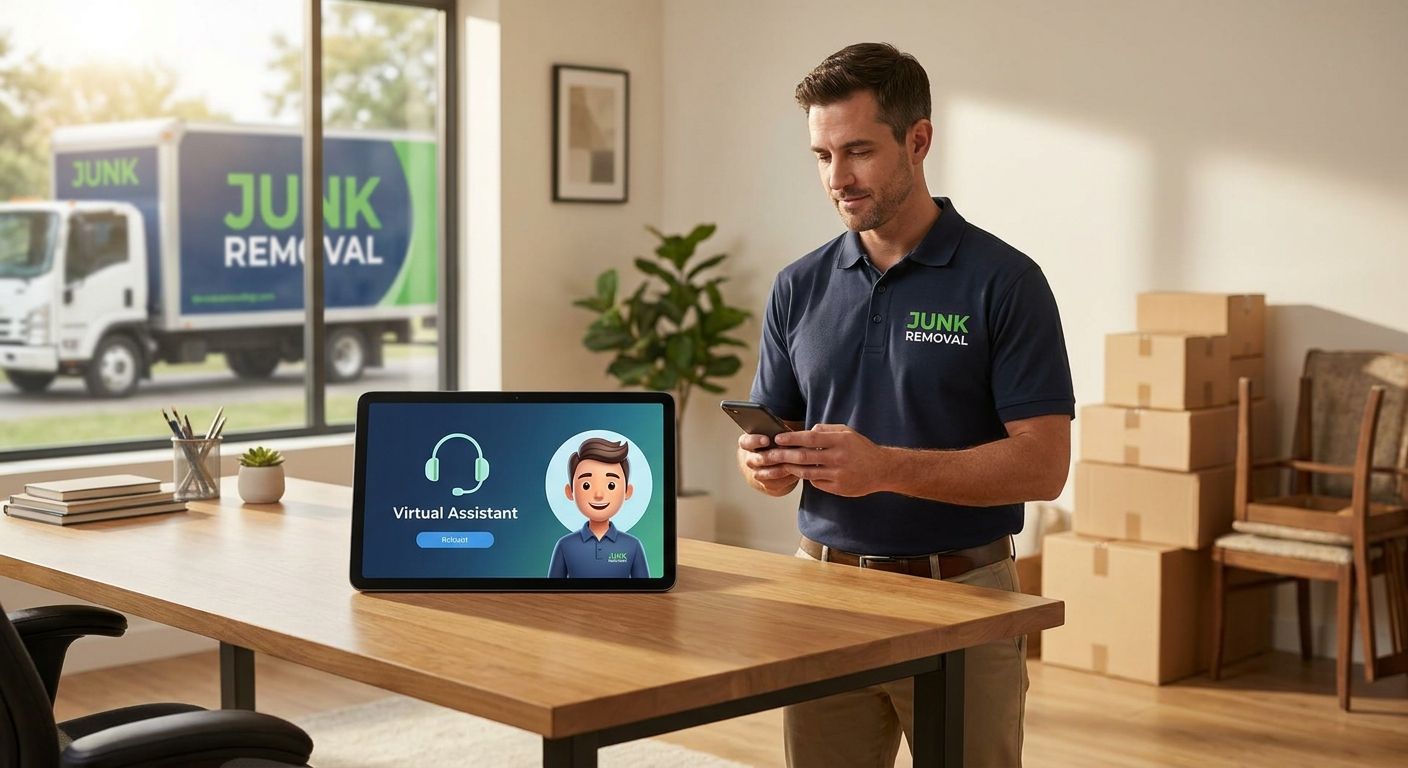
A crew hauling a truck full of debris can't stop mid-route to answer the phone, and every call that rings out is a job calling the next name on the search results page. This guide breaks down what to look for in an ai receptionist for junk removal companies, the buying criteria that actually matter on a hauling crew's schedule, and where SkipCalls fits for solo haulers, multi-truck fleets, and franchise operations running through 2026.
- SkipCalls answers calls 24/7 and books junk removal jobs straight onto your crew's schedule — Buy for any hauling team missing calls mid-route.
- Look for intake scripts built for junk removal: volume, access, stairs, and hazardous items, not a generic answering-service script.
- Skip any AI answering service that can't check live availability and book a same-day 'get this gone today' call.
- Setup runs about 5 minutes on your existing business number — no new hardware, no phone system swap.
Why this matters
Junk removal runs on the phone more than almost any other trade. A customer standing in a garage full of old furniture wants a price and a time slot now, not a callback after your crew wraps the current job. Every unanswered ring is a lead who moves down the search results and calls someone who does pick up.
Spam and lead-gen calls make the problem worse. A crew answering its own phone between stops loses time twice — the real customer sits on hold while the truck sits idle. An AI receptionist for junk removal companies picks up on the first ring, asks the intake questions a dispatcher would ask, and puts a booked job on the calendar before anyone even sees the missed-call notification.
That gap between "phone rang" and "job booked" is where junk removal companies lose revenue that never shows up on any report, because a call that never got answered never got tracked in the first place.
Who this is for
This guide is for junk removal operators running one to ten trucks who lose jobs to voicemail, not to a lack of demand. It's for the solo hauler taking calls from the truck cab, the two-crew operation coordinating dispatch over text, and the multi-location franchise fielding calls from three markets on one shared line.
If your crew spends more hours on a ladder or behind the wheel than behind a desk, this is your buyer profile. If your business already has a full-time dispatcher answering every call within two rings, you probably don't need this guide.
What to look for in an AI receptionist for junk removal companies
Job-specific intake, not a generic script
A junk removal call needs different information than a plumbing call or an HVAC call: what's being hauled, how much of it, whether it's inside a house or sitting in a driveway, and whether stairs or a long carry factor into truck size. A generic answering-service script books an estimate with none of that context, and your crew shows up guessing which truck to send. The AI receptionist needs to ask junk-specific questions before the job ever hits your calendar.
Same-day and on-demand handling
Junk removal is largely an impulse category — someone wants the couch and the old fridge gone today, not next Tuesday. A receptionist that only books three days out loses same-day callers to whichever competitor answers with an open slot. Confirm the system checks live availability and offers the next open truck window on the call itself, not after a manual review.
Text-back and confirmation follow-up
Confirmation texts cut no-shows from both directions — your crew doesn't drive to an empty driveway, and the customer doesn't forget the arrival window. A receptionist that sends a same-day confirmation and a day-of reminder saves more truck time over a month than the phone call itself ever does.
Spam and lead-gen filtering
Junk removal business lines attract a steady stream of insurance calls, warranty spam, and resellers pitching lead lists. An AI receptionist that filters that noise out before it reaches your dispatcher's queue keeps the calendar clean for real jobs, not junk calls about actual junk.
Bilingual coverage
Markets with a sizable Spanish-speaking customer base lose bookings when the receptionist only handles English callers. If your service area skews bilingual, confirm the AI receptionist covers both languages before signing up — this matters more in junk removal than in trades where the person calling isn't always the decision-maker.
Setup speed
A hauling business doesn't have a week to spend on an IT project between jobs. Setup should take minutes, not days. SkipCalls forwards your existing business number and is running in about 5 minutes, with no new hardware and no phone system replacement.
Where an AI receptionist fits your operation
The one-truck operator
The hook: you're the owner, the driver, and the estimator, all at once. One missed call while you're mid-haul is one lost job, full stop. SkipCalls answers on the first ring, captures the job details, and texts you the booking instead of pulling you off the road to check a voicemail. Buy — a single missed call costs more than the setup time ever will.
The two-to-five truck crew
The hook: dispatch is outgrowing a shared group chat and a whiteboard. Calls need to land on the right truck's schedule, not just "somewhere this week." Crews that also haul renovation debris for general contractors run into the same scheduling bottleneck at a bigger scale. Buy for any crew past the point where one shared phone can cover a full day of calls.
The franchise or multi-location brand
The hook: three markets, three phone numbers, one dispatcher trying to keep it straight. Routing calls to the right location by ZIP code or area code matters more here than intake depth alone. Confirm the AI receptionist can route by location before rolling it out across every market. Consider — worth a pilot on your busiest location first.
The seasonal-surge business
The hook: spring cleanouts and moving-season spikes can double call volume for a six-to-eight week stretch. A part-time answering service can't scale that fast without extra hiring; an always-on AI receptionist doesn't need extra staffing to absorb the surge. Buy if your call volume swings hard by season — that's exactly where missed calls cost the most.
Stop losing jobs to voicemail
Set up an AI receptionist for junk removal calls in about 5 minutes.
What to avoid
- Generic answering services that read from a script with no junk-removal-specific questions — you'll get a booked appointment with no idea what truck size to send or how many workers the job needs.
- Voicemail-only setups that ask customers to leave a message and wait for a callback — in an impulse category like junk removal, that caller has usually already dialed the next company by the time you return the message.
- Answering services that can't confirm same-day slots — if the system can't check live truck availability during the call, it can't book the jobs that matter most, which are the ones people want handled today.
Verdict comparison
| Criteria | AI receptionist (SkipCalls) | Generic answering service | Voicemail only |
|---|---|---|---|
| Junk-specific intake | Built for volume, access, hazard questions | Rare, generic script | None |
| Same-day booking | Live calendar check on the call | Manual callback | No booking at all |
| Availability | 24/7 | Business hours or shift-based | Anytime, no live response |
| Setup time | About 5 minutes | Days to weeks, contracts and scripting | None needed |
| Spam filtering | Built in | Rare | None |
Verdict: buy an AI receptionist built for junk removal calls over a generic answering service or plain voicemail. The intake depth and same-day booking are the difference between a job landing on the calendar in 2026 and a lead that called your competitor instead.
FAQ
What's the best AI receptionist for junk removal companies?
The best AI receptionist for junk removal companies handles job-specific intake like volume, access, and stairs, then books the job onto a live schedule. SkipCalls is built for this in 2026 — it answers 24/7 and routes booked jobs straight to your crew's calendar.
Is an AI receptionist better than a human answering service for junk removal?
For junk removal specifically, yes in most cases. A human answering service usually reads a generic script and can't check live truck availability, while an AI receptionist built for the trade asks the right questions and books same-day slots without hold time.
Can an AI receptionist book same-day junk removal jobs?
Yes, if it checks live calendar availability during the call. Junk removal is largely an impulse category, and a system that only offers callbacks or next-week slots loses same-day customers to whichever competitor books on the spot.
How much does an AI receptionist cost for a junk removal business?
Cost depends on call volume and the provider's plan structure, so check current pricing directly with the provider. Compare that against what a human answering service charges monthly before deciding.
How long does it take to set up an AI receptionist?
SkipCalls sets up in about 5 minutes by forwarding your existing business number, with no new hardware and no phone system replacement required.
Do AI receptionists handle Spanish-speaking customers?
Bilingual coverage varies by provider, so confirm it before signing up if your service area has a large Spanish-speaking customer base. This matters more in junk removal, where the person calling is usually the one deciding whether to book.
Can I cancel an AI receptionist service anytime?
Cancellation terms vary by provider, so confirm them before signing up. SkipCalls is built around a cancel-anytime model rather than locking operators into long contracts.
Does an AI receptionist replace my dispatcher?
No, it handles the phone call and books the job, but a dispatcher still assigns trucks and manages the day's route. Think of it as removing the missed-call problem, not replacing the person running your schedule.
One last thing
Junk removal companies rarely lose business to bad reviews — they lose it to the phone ringing four times and hitting voicemail while the crew hoists a couch into the truck bed. Fix the call, and the review problem mostly takes care of itself, because the jobs that get booked are the ones that get done. In 2026, the junk removal companies growing fastest aren't the ones with the newest trucks — they're the ones that answer every call.