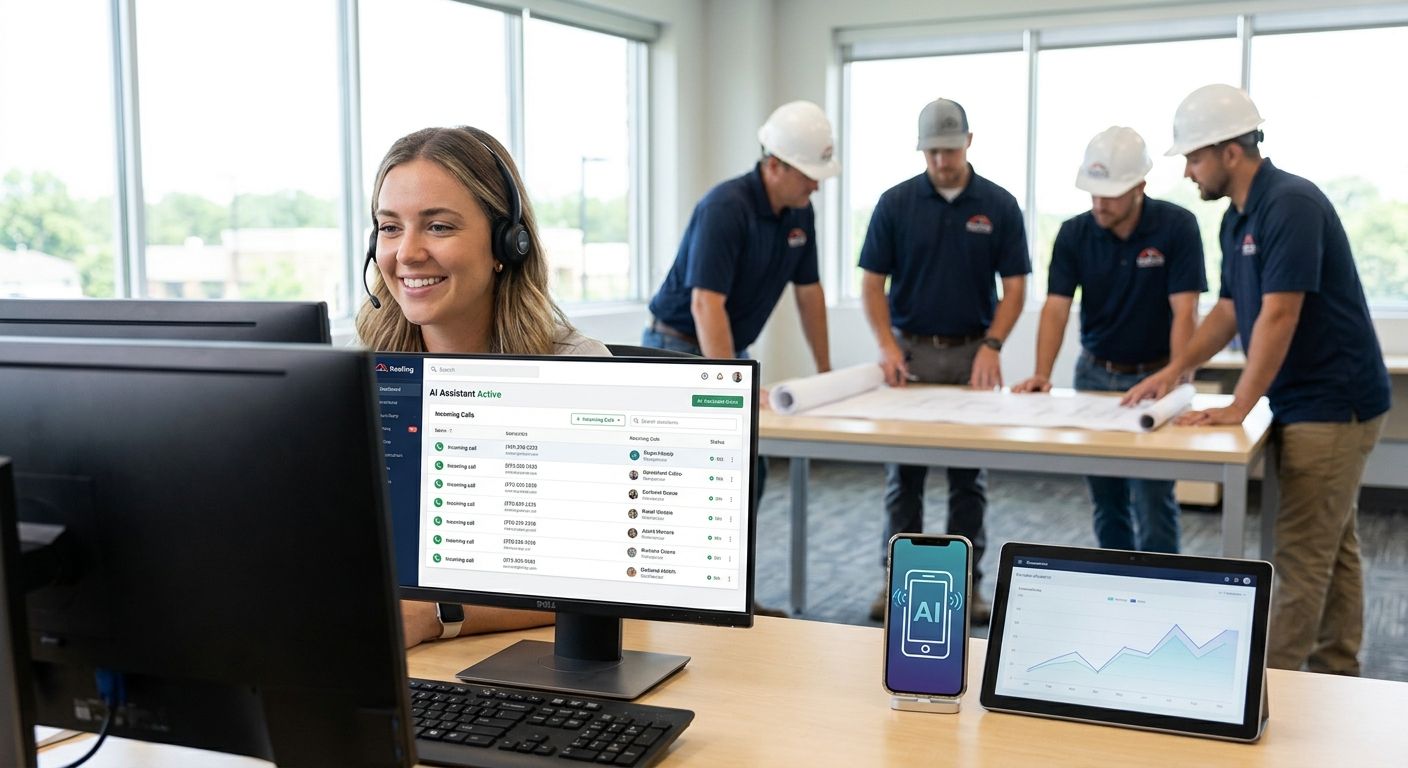
Missed calls during a hailstorm rush aren't lost revenue — they're leads your competitor is closing tonight. AI phone answering for roofing companies fixes the gap between the moment a homeowner calls about a leak and the moment someone on your crew can pick up.
- SkipCalls answers every roofing call in under 2 rings and books the job straight to your calendar — Buy for storm-season overflow.
- Traditional live answering services charge per-minute and can't quote or schedule roof-specific jobs — Consider only as a stopgap.
- Voicemail and callback loops lose an estimated 20-30% of storm-damage leads to the first company that answers live.
- AI phone answering for roofing companies works best when it captures address, roof type, and insurance status on the first call.
Why this matters
A roofing crew on a ladder can't stop to answer a phone, and a homeowner with a leaking ceiling won't wait for a callback. Every ring that goes unanswered in 2026 is a call that lands on the next name in the search results.
Storm season compounds the problem. Call volume can triple in a 48-hour window after a hail event, and a two-person office can't staff for that spike without burning out on quiet weeks. AI phone answering for roofing companies solves the volume problem without adding headcount — the system answers call one and call fifty the same way, at 2am or 2pm.
Who this is for
This guide is for roofing company owners and office managers running crews of 2 to 40 people who lose jobs to voicemail, especially during storm season when the phone won't stop ringing. If your team is already answering every call live and closing every lead, you don't need this — but if a $650 repair job or a full re-roof estimate has ever slipped to a competitor because nobody picked up, keep reading.
What to look for in AI phone answering for roofing companies
Storm-season call volume handling
A system that works fine on a normal Tuesday and falls apart during a hail event isn't built for roofing. Look for answering that scales the same at call 5 and call 500 in a single day, because storm surges are when missed calls cost the most.
Job-detail capture, not just a name and number
A roofer needs the address, roof type, approximate age, and whether the homeowner has already filed an insurance claim — not just "call this person back." The right system captures those details on the first call so your crew can triage instead of playing phone tag.
Scheduling and routing, not a message slip
An answering service that just takes a message still leaves the homeowner waiting on you. Booking and routing straight to your calendar is what turns an answered call into revenue on your schedule instead of a sticky note.
Spam and robocall filtering
Roofing companies get hammered with spam calls, especially after storm events when lead-gen scammers spike too. A system that filters junk before it hits your crew's phones saves real time, not just theoretical time.
Setup speed and no long-term lock-in
A roofing business can't wait three weeks for an onboarding call. Setup in 5 minutes and the ability to cancel anytime matters more than a feature list nobody reads.
Bilingual coverage
Many roofing markets, especially in the South and Southwest, run 30% or more of homeowner calls in Spanish. A system that only handles English loses those leads outright.
Top picks: your options for handling roofing calls
SkipCalls — the always-on option
SkipCalls is built as an AI receptionist for service businesses, including roofing, and answers calls in under 2 rings around the clock. It captures job details — address, roof type, damage description — and books directly to your calendar instead of leaving a message for a callback.
The concrete number that matters: setup takes about 5 minutes, and there's no contract lock-in — you can cancel anytime. For a roofing company running lean during storm season, that means no callbacks, no phone tag, and jobs landing on the schedule while the crew is still on the roof.
Verdict: Buy for any roofing company that misses calls during peak hours or storm surges. Set up AI phone answering and stop losing jobs to voicemail.
Traditional live answering service — the expensive middle ground
A human-staffed answering service picks up the phone and takes a message, sometimes with basic scripting. It doesn't understand roofing-specific intake — roof pitch, material type, insurance claim status — so calls still get routed back to you for the real conversation.
Billing is usually per-minute or per-call, which gets expensive fast during a storm-driven spike in volume. Verdict: Consider only if you need a short-term bridge while switching systems — it's not built for scale.
Hiring an in-house receptionist — the overkill option
A dedicated person answering phones works during business hours, but nobody wants a night-shift receptionist for a 2am leak call. You're also paying full salary and benefits for coverage that drops to zero the moment they take lunch or go home.
For a company with under 15 employees, the math rarely works — the cost of a full-time hire outweighs the job volume most crews handle in a slow month. Verdict: Skip unless your roofing company has enough call volume to justify a full-time role and multiple shifts.
Voicemail plus manual callback — the leaky bucket
This is the default for most small roofing companies, and it's the cheapest option on paper. The problem is the lag: a homeowner with an active leak calls three roofers, and the first one to answer live usually wins the job.
Every hour a callback sits unreturned is another chance the lead calls a competitor instead. Verdict: Skip as a primary strategy — fine as a backup, not as your front line during 2026's storm season.
Shared office manager answering multiple lines — the stretched-thin option
Some smaller roofing operations have one office person juggling phones, scheduling, invoicing, and supplier calls at once. Calls get answered, but slowly, and job details often get written down incompletely between other tasks.
This works when call volume is low and steady, but it breaks the moment a storm rolls through and the phone rings nonstop. Verdict: Consider only for companies doing under 10 calls a day with minimal seasonal swings.
Stop losing roofing jobs to voicemail
Answer every call in under 2 rings and book jobs straight to your calendar.
What to avoid
- Generic chatbots that only text back. A text auto-reply doesn't answer the phone or capture roof-specific details — it just delays the same problem.
- Answering services with hidden per-minute overage fees. These look cheap on the intro call and get expensive the first month you run a storm-driven call spike.
- Systems that can't route emergency calls differently from routine ones. A leak-in-progress call needs different handling than a routine inspection request, and a flat script treats them the same.
Comparison table
| Option | Handles storm surges | Captures job details | Cost model | Setup time | Verdict |
|---|---|---|---|---|---|
| SkipCalls (AI receptionist) | Yes, same speed at any volume | Address, roof type, damage, insurance | Flat, cancel anytime | ~5 minutes | Buy |
| Live answering service | Limited, slows under volume | Basic message only | Per-minute/per-call | Days to weeks | Consider |
| In-house receptionist | No, single shift only | Full detail, business hours only | Salary + benefits | Weeks (hiring) | Skip (small teams) |
| Voicemail + callback | No, delays every lead | None until callback | Free | None | Skip |
| Shared office manager | No, breaks under spikes | Partial, inconsistent | Existing salary | None | Consider (low volume) |
FAQ
What is AI phone answering for roofing companies?
It's a service that answers every incoming call to a roofing business automatically, capturing job details like address and roof damage, then booking or routing the call without a human receptionist. SkipCalls answers in under 2 rings and books straight to your calendar in 2026.
Is AI phone answering better than a live answering service for roofers?
For storm-season volume, yes — AI answering scales instantly while live services slow down and bill per minute during spikes. Live services still handle nuanced conversations better, but most roofing calls are routine intake that AI captures fine.
How much does AI phone answering cost for a roofing company?
Pricing varies by provider and call volume, so check current plans directly with the vendor before committing. Compare that against the per-minute fees of a live answering service, which climb fast during storm-driven call surges.
Can AI phone answering handle emergency roof leak calls?
Yes, when the system is set up to flag urgent language like "active leak" or "water coming in" and route those calls differently than routine estimate requests. Not every provider offers this distinction, so confirm it during setup.
Does AI phone answering work for bilingual roofing calls?
Some AI receptionist platforms support Spanish and English call handling, which matters in markets where a third or more of homeowner calls come in Spanish. Confirm bilingual support before signing up if your service area needs it.
How fast can a roofing company set up AI phone answering?
SkipCalls sets up in about 5 minutes with no long-term contract required. That's fast enough to deploy mid-storm-season if your current setup is already dropping calls.
Does AI phone answering replace my office staff?
No — it handles the phone intake and booking so your office staff can focus on scheduling crews, ordering materials, and following up on estimates instead of answering every ring. Most roofing companies run it alongside existing staff, not instead of them.
What information should AI phone answering capture for roofing leads?
At minimum: address, roof type, approximate age, description of the damage, and whether an insurance claim is already filed. That detail lets your crew triage the call before ever calling the homeowner back.
One last thing
The roofing companies that win storm-season leads aren't the ones with the best marketing — they're the ones who pick up the phone first. A homeowner with a leak calls three roofers in the first ten minutes after the storm passes, and the job usually goes to whoever answers live, not whoever calls back an hour later. In 2026, that math hasn't changed; the only thing that has is how cheap it's become to never miss that first call again.